


News
OpenCV Officially Supports LoongArch
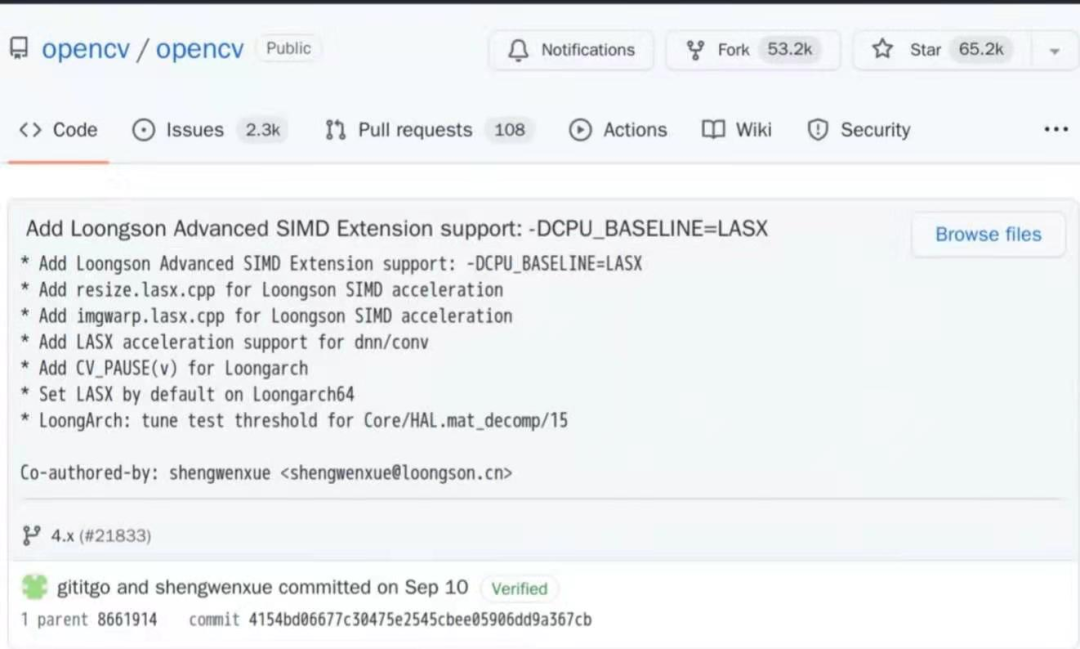
OpenCV community announced recently that LoongArch codes have been officially merged into the library, significantly improving the performance of OpenCV based on LoongArch.
OpenCV (Open Source Computer Vision Library) is a cross-platform library that is widely used in the field of computer vision and serves as a fundamental platform for artificial intelligence applications. Currently, OpenCV supports the main CPU architectures available on the market, including X86, ARM, and others. With the integration of LoongArch codes, OpenCV has officially supported LoongArch.
Loongson Technology is actively investing in AI platforms revolving around LoongArch. It has built a multi-level AI software ecosystem and a comprehensive heterogeneous hardware support system to meet the requirements for different AI application scenarios, such as cloud, edge, and endpoint.
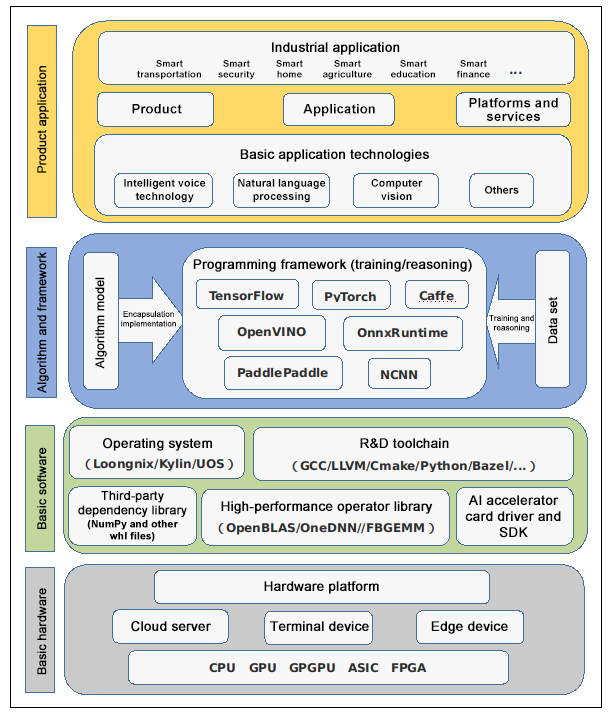
Adaptation of Basic Libraries and Programming Frameworks
On the one hand, high-performance operator libraries such as OpenBLAS, OneDNN, and FBGEMM have all been adapted and optimized based on LoongArch. On the other hand, deep learning programming frameworks commonly used at home and abroad, including TensorFlow, PyTorch, Caffe, OnnxRuntime, PaddlePaddle, and NCNN, have also been adapted and optimized. Additionally, common algorithm models in the fields of computer vision and NLP can be normally deployed and run.
LoongArch-Based AI Application Solutions
Numerous domestic AI accelerator card manufacturers, including Iluvatar CoreX, Denglin Technology, and Intellifusion Technologies, have all completed the adaptation on the LoongArch platform. The adaptation involves multiple areas, such as GPGPU, ASIC, and FPGA. As a result, these companies have built a comprehensive heterogeneous hardware support system for LoongArch-based AI application solutions.
LoongArch-based AI application solutions can satisfy the requirements for computing power in different application scenarios, including the cloud, edge, and endpoint. These solutions cover computer vision, natural language processing, and other fields, and serve industries such as security, transportation, education, energy, and data centers.

